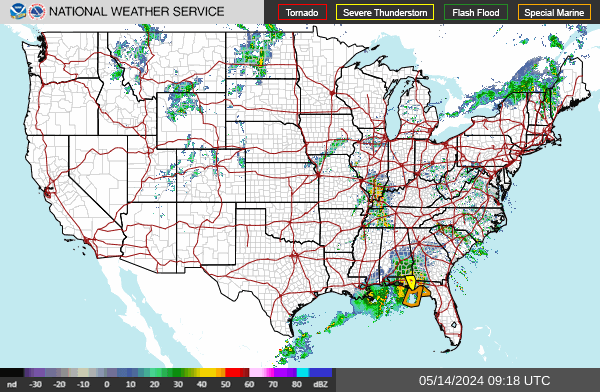
Live National Weather Service data
Watch vs warning
A watch means conditions are favorable. Be ready. A warning means danger is occurring, imminent or very likely. Act on the official instructions now.
WATCH
Conditions are favorable. Be ready.
WARNING
Danger is occurring, imminent or very likely. Act now.
Read the hazard named in the alert. Some warnings are issued ahead of expected conditions, including hurricanes. Follow the official warning's instructions rather than waiting to see danger.
What the National Weather Service says
Watch
A watch is used when the risk of a hazardous weather or hydrologic event has increased significantly, but its occurrence, location, and/or timing is still uncertain.
- Issued by
- It depends on the hazard. The Storm Prediction Center issues tornado and severe thunderstorm watches. The National Hurricane Center and Central Pacific Hurricane Center issue tropical cyclone watches for their regions. Your local National Weather Service office issues most others.
- Area covered
- Watch areas are usually large. One watch can cover many counties or parts of several states.
Warning
A hazardous weather or hydrologic event is occurring, is imminent, or has a very high probability of occurring. A warning is issued for conditions posing a threat to life or property.
- Issued by
- Your local National Weather Service office issues tornado and severe thunderstorm warnings. The National Hurricane Center and Central Pacific Hurricane Center issue tropical cyclone warnings for their regions.
- Area covered
- Warning areas are smaller and more specific than watch areas.
Advisory
Highlights special weather conditions that are less serious than a warning. They are for events that may cause significant inconvenience, and if caution is not exercised, it could lead to situations that may threaten life and/or property.
- Issued by
- Your local National Weather Service office.
The wording above is the National Weather Service's own. It is quoted, not rewritten.
A watch does not always become a warning, and a warning is not always preceded by a watch. Treat every warning as real either way.
A memory aid that actually sticks
A watch is the ingredients on the counter. You could have tacos. A warning is the taco in your hand. You are having tacos. It is a memory aid, not National Weather Service language. The definitions above are the wording that counts.
The analogy is not ours. Emergency managers and TV meteorologists have used it for years, and the version that spread nationally came from the Normal Fire Department in Normal, Illinois, in 2021. No agency owns it. Coverage
What to do
When a watch is issued
- Find out which hazard the watch is for. The alert names it.
- Decide now where you would go and what you would do if it becomes a warning.
- Turn on the emergency alerts in your phone settings.
- Check the batteries in your weather radio.
- Charge your phone.
- Bring in or tie down anything outside that could blow around.
- Stay where you can hear an alert.
When a warning is issued
- Read which warning it is. The alert names the hazard.
- Do the action for that hazard right now. A tornado sends you to the lowest interior room. A flood sends you to higher ground. Those are opposite actions, so get the hazard right.
- Do not wait to see or hear the storm yourself.
- Follow the protective action in the official warning and local evacuation instructions. Keep checking official updates.
When an advisory is issued
- Expect the conditions to slow you down or make travel harder.
- Postpone outdoor plans that would leave you exposed.
- Keep checking. An advisory can be upgraded to a warning.
Common questions
Is a watch worse than a warning?
No. A warning is the more serious one. A watch means conditions are favorable for a hazard, so be ready. A warning means the hazard is occurring, is imminent, or has a very high probability of occurring, so act now.
Source: forecast.weather.gov/glossary.php?word=WARNINGIs a watch better than a warning?
A watch means conditions favor the hazard, so prepare now. A warning means the hazard is occurring, imminent or very likely. Act on the official instructions. Timing and protective actions depend on the hazard, and local evacuation instructions still apply during a watch.
Source: forecast.weather.gov/glossary.php?word=WATCHWhat is the difference between a watch, a warning, and an advisory?
A watch means the risk of a hazardous event has increased significantly, but its occurrence, location, or timing is still uncertain. A warning means the event is occurring, is imminent, or has a very high probability of occurring, and it threatens life or property. An advisory covers conditions that are less serious than a warning but can still cause significant trouble if you are not careful.
Source: forecast.weather.gov/glossary.php?word=ADVISORYDoes a watch always turn into a warning?
No. A watch means the risk went up, not that the event is certain. Plenty of watches expire with nothing happening at your address, and some warnings are issued with no watch beforehand. Treat every warning as real whether or not a watch came first.
Source: forecast.weather.gov/glossary.php?word=WATCHWho issues watches and warnings?
The Storm Prediction Center issues tornado and severe thunderstorm watches. Local National Weather Service offices issue tornado and severe thunderstorm warnings. The National Hurricane Center and Central Pacific Hurricane Center issue tropical cyclone watches and warnings for their regions.
Source: www.spc.noaa.gov/faqHow warnings reach your phone
The National Weather Service marks its most critical alerts for delivery to cell phones as Wireless Emergency Alerts. The list is warnings only.
Those are warnings for tsunamis, tornado, severe thunderstorm when the damage threat is destructive, flash flood when the damage threat is considerable or catastrophic, hurricane, typhoon, storm surge, extreme wind, dust storm, and snow squall.
You will not get a phone alert for a watch. A quiet phone is not proof that nothing is happening. Check that emergency alerts are turned on in your phone settings.
Source: www.weather.gov/wrn/weaHow warnings reach you when the phone does not
NOAA Weather Radio All Hazards is a nationwide network of radio stations broadcasting continuous weather information directly from the nearest National Weather Service office. It broadcasts official Weather Service warnings, watches, forecasts and other hazard information 24 hours a day, 7 days a week.
It carries watches as well as warnings, and it does not depend on cell service. It needs a special radio receiver or scanner.
Source: www.weather.gov/nwrAbout outdoor sirens
Cities and counties own outdoor warning sirens and decide when to sound them. The National Weather Service does not sound them, and policies differ from one place to the next.
Sirens are built to warn people who are outdoors. They are not built to be heard indoors. Do not make a siren your only alert.
Source: www.weather.gov/dvn/sirenFAQSources
- NWS Glossary: Watch
- NWS Glossary: Warning
- NWS Glossary: Advisory
- Storm Prediction Center FAQ
- NHC Glossary of Terms
- NWS: Hurricane watches, warnings and evacuation instructions
- NWS: Wireless Emergency Alerts
- NOAA Weather Radio All Hazards
- NWS Quad Cities: Outdoor Warning Sirens FAQ
- National Weather Service (find your local office)
Storm Season Pass, $19
Three years of past watches and warnings for your address. One payment, five months, does not renew.
Live status and official safety information stay free.